San Francisco's hop-on hop-off bus covers 17+ stops across one of the most visually dramatic cities in the world. But not every stop deserves your time on the ground, and with a full loop taking around 2 hours, making the wrong call means waiting 15–20 minutes for the next bus while missing something genuinely worth getting off for.
You have to check out the Golden Gate Bridge, North Vista Point, Fisherman's Wharf, Painted Ladies (Alamo Square), Haight-Ashbury, and Palace of Fine Arts. Stay on through Lombard Street, Chinatown, and the Financial District.
But, the problem is that most guides just list the stops. They don't tell you which ones reward the wait, which ones are actually better viewed from the top deck as you roll through, and which ones sound good on paper but disappoint in reality.
This guide does exactly that — ranking the key stops honestly, with specific tips on what to do, how long to spend, and what to watch out for — so you get the most out of every hour on your ticket.
Do the Full Loop Before You Hop Off Anywhere
This is the single most useful piece of advice for any first-time San Francisco HOHO rider — and almost nobody does it.
Before you hop off at a single stop, ride the entire route once from start to finish. The full loop takes around 2 hours and gives you an immediate, visceral understanding of how the city is laid out — where the waterfront sits relative to the hills, how far Haight-Ashbury is from Fisherman's Wharf, what the Golden Gate Bridge actually looks like from the bus as you cross it for the first time.
San Francisco is a city that genuinely confuses first-time visitors. It looks compact on a map but feels enormous on foot because of the hills. Distances that appear walkable are separated by brutal inclines that even fit adults find punishing.
Doing the full loop first means you make informed decisions about where to spend your ground time — not guesses based on a map you consulted in your hotel.
Board at the Big Bus Visitors' Center, 99 Jefferson Street, Fisherman's Wharf (corner of Jefferson and Mason Streets). First bus departs at 10am. Ride the full Red Route loop, then start hopping off on the second pass.
Must Get Off: The Stops Worth Every Minute
1. Golden Gate Bridge — North Vista Point
The single unmissable stop on the entire route.
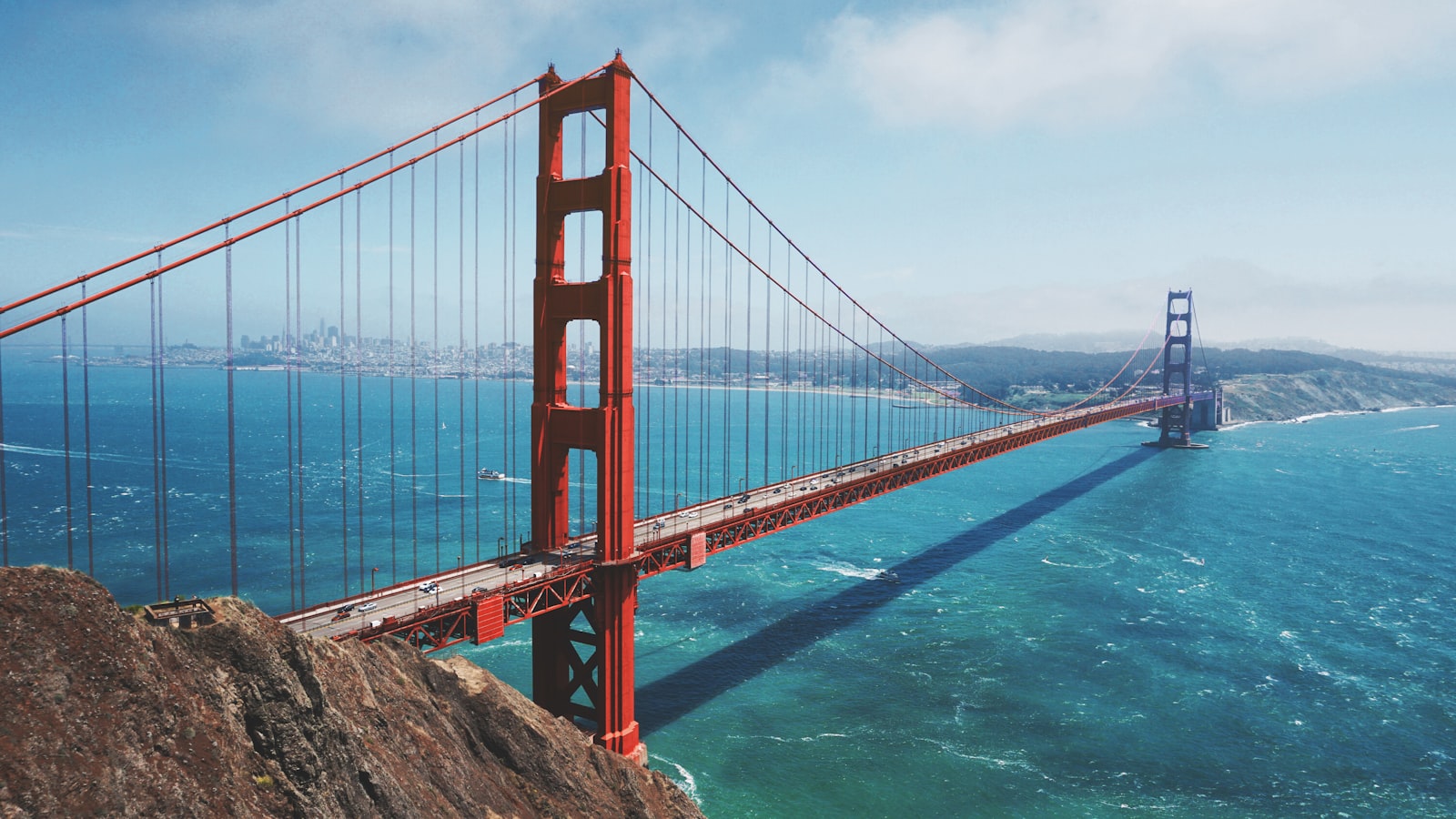
The bus crosses the Golden Gate Bridge and deposits you at the North Vista Point lookout on the Marin County side — a viewpoint most tourists never reach because there is simply no easy public transport connection here.
From this point you get the full iconic view: the two rust-red towers framing the bay, the San Francisco skyline stretching out behind them, Alcatraz Island sitting in the middle distance, and on clear days the hills of the East Bay completing the panorama.
This is the postcard shot. Not the view from the city side — the view from here. And it's only accessible from this stop.
The bus pauses here for a photo stop before returning across the bridge. Check with your driver for the exact wait time — it varies by schedule — but typically you have 20–30 minutes on the Marin side before the bus continues. If you want longer, you can wait for the next bus (allow 15–20 minutes).
Practical tips:
• Bring a jacket regardless of what the weather looks like in the city. The wind on and around the bridge is consistently fierce, even in August, and the fog rolls in from the Pacific with very little warning. Visitors in shorts and t-shirts in summer are visibly cold every single day.
• The North Vista Point can get crowded fast when multiple buses arrive together. Walk to the far eastern end of the viewpoint for a slightly less congested angle.
• Download the Big Bus app before you arrive — it shows live bus locations so you know exactly when the next bus back will arrive.
2. Fisherman's Wharf / Pier 39
Your natural base — and the best place to start your day.
The Big Bus Visitors' Center at 99 Jefferson Street sits at the heart of Fisherman's Wharf, making this the most logical starting point for your day. Pier 39 is a 3-minute walk from the bus stop, and the sea lions that colonised the K-Dock in 1989 remain one of San Francisco's most entertaining free attractions — loud, chaotic, and completely unpredictable.
Beyond the sea lions, Fisherman's Wharf is where you pick up the Bay Cruise if it's included with your ticket (departs from Pier 41, steps away), where you'll find San Francisco's famous sourdough bread bowls filled with clam chowder (the Boudin Bakery on Jefferson Street is the original), and where Ghirardelli Square sits a short walk west with its famous free chocolate samples and bay views.
Practical tips:
• Start here early — before 10am if possible. By midday the waterfront is packed and the queues at Pier 39 restaurants are long.
• The Bay Cruise departs from Pier 41, a 5-minute walk from the bus stop. If a Bay Cruise is included in your ticket combo, do it from here in the morning before the wind picks up on the bay in the afternoon.
• Ghirardelli Square is a 10-minute walk west along the waterfront — worth doing before you board the bus for the day.
3. Painted Ladies — Alamo Square
The most photographed houses in America. Every cliché is earned.
The row of seven Victorian townhouses on Steiner Street, set against the Downtown San Francisco skyline, is one of those sights that you've seen a thousand times in photos and somehow still manages to hit differently in person.
The contrast between the ornate, pastel-painted facades and the glass towers of the Financial District behind them is genuinely striking — and Alamo Square Park, the sloped green space directly opposite, gives you the perfect elevated angle.
The Painted Ladies appear in the opening credits of Full House, in countless films and travel campaigns, and on approximately half of all San Francisco postcards. There's a reason. They're worth getting off for.
The surrounding neighbourhood — a grid of Victorian and Edwardian homes in blues, lavenders, greens, and yellows — is lovely to walk for 15 minutes in any direction. This is one of the most intact concentrations of Victorian residential architecture in the United States.
Practical tips:
• Come in the morning for the best light and the smallest crowds. The park bench directly opposite the houses fills with photographers from mid-morning onwards.
• From Alamo Square you can walk 10–15 minutes downhill through the Hayes Valley neighbourhood, which has excellent independent coffee shops and boutiques, before catching the next bus.
• The Painted Ladies stop is on the Yellow Route (Painted Ladies and Haight-Ashbury Tour) — check your ticket to confirm Yellow Route access, as not all ticket tiers include it.
4. Haight-Ashbury
The most characterful neighbourhood on the entire route.
The corner of Haight Street and Ashbury Street is where the 1960s counterculture took root, and more than five decades later the neighbourhood still carries that energy.
Independent record shops selling vinyl, vintage clothing stores that haven't changed since 1975, murals covering entire building facades, and the Jimi Hendrix house (a red three-storey building near the corner where Hendrix lived in the mid-1960s) tucked between a café and a boutique.
This is not a sanitised tourist attraction. It's a living, functioning neighbourhood that happens to be historically extraordinary.
Walking Haight Street for 20–30 minutes gives you a feel for San Francisco's counterculture legacy that no amount of audio commentary from the top deck can replicate.
Practical tips:
• The bus stop is at 1816 Haight Street, opposite the Cha Cha Cha restaurant. From here you can walk the full stretch of Haight Street west toward Golden Gate Park in about 15 minutes.
• Buena Vista Park sits just south of Haight Street and offers elevated views over the city. It's a steep but short climb.
• From Haight-Ashbury you can walk 10 minutes east to catch the bus again at the Painted Ladies stop — making a natural loop between the two stops without backtracking.
5. Palace of Fine Arts
Underrated. Most tourists stay on the bus. Don't.
The Palace of Fine Arts is a monumental Roman and Greek Revival rotunda on the edge of the Marina District, built as a temporary structure for the 1915 Panama-Pacific International Exposition and preserved — after much public campaigning — as a permanent landmark.
It is completely free to enter and walk around, genuinely stunning in its scale and detail, and almost always far less crowded than the waterfront stops.
The central rotunda is surrounded by a colonnaded walkway that frames a lagoon, in which the dome and columns reflect perfectly on calm mornings. The combination of neoclassical architecture, still water, and the surrounding eucalyptus trees makes this one of the most unexpectedly beautiful spots in the entire city.
Practical tips:
• Morning visits offer the best reflections in the lagoon and the fewest other visitors.
• From the Palace of Fine Arts it's a 10-minute walk north through the Presidio to the bay shoreline at Crissy Field, where you get excellent eye-level views of the Golden Gate Bridge from the city side — a completely different perspective from the North Vista Point stop.
• Allow 20–30 minutes here. It's not a museum — it's an architectural experience and a walking space.
Top Deck Only: Better Viewed From the Bus
1. Lombard Street
The "crookedest street in the world" is one of San Francisco's most requested stops — and one of the most consistently underwhelming on the ground. The bus stop deposits you at the bottom of the hill on Lombard Street, not the top.
To get the famous view of the eight tight switchbacks lined with hydrangeas descending the hill, you need to climb to the top — which means walking several steep blocks uphill before you can look down at what you came to see.
The view from the top deck of the bus as you approach and pass along Lombard is actually a more satisfying perspective than standing at the bottom looking up. Stay on, take your photos from the upper deck, and save your leg energy for stops that reward the effort.
2. Chinatown / North Beach
The bus rolls through both neighbourhoods at street level along Columbus Avenue and Grant Avenue, which gives you a genuine feel for the dense, colourful energy — the red lanterns strung across the street, the produce stalls spilling onto the pavement, the Italian cafés of North Beach packed with morning espresso drinkers.
Unless you specifically want to stop for dim sum lunch or a coffee at Caffe Trieste, the rolling view from the upper deck gives you enough.
3. Financial District / Embarcadero
The Transamerica Pyramid, the Ferry Building's clock tower, the approach to the Bay Bridge — all impressive from the top deck and all better appreciated in motion than on foot.
The Ferry Building Marketplace (open Tuesday, Thursday, and Saturday mornings) is the one exception: if you're there on a market day and food is a priority, it's worth a 30-minute stop. Otherwise, keep rolling.
Skip: Stops That Don't Reward the Wait
1. Civic Center
San Francisco's City Hall is architecturally impressive — the gold dome is larger than the US Capitol's — but the surrounding Civic Center plaza doesn't reward tourist foot traffic in the way that most other stops do.
Unless you have a specific reason to be here (a museum visit, a performance at the Opera House), the view from the bus is sufficient and your hop-off time is better spent elsewhere.
2. Union Square
A busy shopping and hotel district that most visitors pass through naturally at the start or end of their day.
It's the most convenient boarding point if you're staying nearby — and a perfectly logical place to start your loop — but hopping off mid-tour to walk around department stores burns ticket time you'd rather spend at the bridge or Haight-Ashbury.
Board here if it's near your hotel; don't make a detour for it.
Recommended Stop Order for One Day
If you're doing the full Red Route on a single day, here's the sequence that makes the most practical sense:
1. Board at Fisherman's Wharf, 10am: Sea lions at Pier 39, sourdough chowder at Boudin, Bay Cruise from Pier 41 if included
2. Stay on through Chinatown and North Beach: Top deck views, no need to hop off
3. Hop off at Painted Ladies / Alamo Square: 30–40 min, morning light, walk Hayes Valley
4. Hop off at Haight-Ashbury: 30–45 min, walk Haight Street, loop back via Buena Vista Park
5. Stay on through Golden Gate Park: Top deck views of the park and Panhandle
6. Hop off at Golden Gate Bridge North Vista Point: 30–45 min, bring a jacket, best photos of the trip
7. Hop off at Palace of Fine Arts: 20–30 min, walk to Crissy Field for city-side bridge views
8. Return to Fisherman's Wharf: Evening Bay Cruise or Night Sightseeing Tour from 6:30pm
Frequently Asked Questions
1. Which stop on the San Francisco hop-on hop-off bus has the best view?
The Golden Gate Bridge North Vista Point — it's the only stop that gives you the full iconic view of the bridge with the San Francisco skyline behind it. It's not accessible by any other easy public transport, making it one of the strongest practical arguments for taking the HOHO bus in the first place.
2. Should I ride the full loop before hopping off?
Yes — strongly recommended for first-time visitors. The full Red Route loop takes around 2 hours and gives you an essential understanding of how the city is laid out before you commit your ground time to specific stops. San Francisco looks deceptively compact on a map but is much more spread out in reality because of the hills.
3. How often do the buses run in San Francisco?
Every 15–20 minutes on the Red Route during peak season (summer). Frequency drops in winter. Download the Big Bus app before you arrive — it shows live bus locations and real-time arrival estimates at every stop. The physical stop signs are minimal, so the app is essential for knowing when the next bus is coming.
4. Is the Painted Ladies stop on the Red Route or Yellow Route?
The Painted Ladies (Alamo Square) stop is on the Yellow Route (Painted Ladies and Haight-Ashbury Tour). Check your ticket carefully — some passes include both Red and Yellow Routes, which together give you the most complete coverage of the city. If your ticket only covers the Red Route, you'll need to upgrade or purchase separately.
5. What should I wear on the San Francisco hop-on hop-off bus?
Layers, always. San Francisco's weather is famously unpredictable — it can be warm and sunny at Fisherman's Wharf and cold and foggy at the Golden Gate Bridge simultaneously. Always bring a jacket, and if you're crossing the bridge on the top deck, add a hat and scarf regardless of the season or the morning forecast.
6. Is the San Francisco hop-on hop-off bus worth it?
Yes, particularly for first-time visitors. San Francisco's hills, spread-out neighbourhoods, and limited public transport connections between major landmarks make the HOHO bus a genuine practical solution, not just a tourist novelty. The Golden Gate Bridge North Vista Point stop alone justifies the ticket price for most visitors, since there's no other easy way to reach that viewpoint.
7. Do I need to book in advance?
Yes, book online before you travel. Walk-up prices at the stop are higher than online rates, and the tour sells out on weekends and during peak summer (June–August). Online booking also gives you date flexibility and instant e-ticket delivery so you can board directly without queuing.
San Francisco's hop-on hop-off route is one of the best-value sightseeing formats in any American city — because the city's geography genuinely makes the bus useful, not just scenic.
The hills are steep, the distances are deceptive, and the Golden Gate Bridge North Vista Point is simply not reachable any other way without a car or an expensive cab.
Get off at the Golden Gate Bridge, Fisherman's Wharf, Painted Ladies, Haight-Ashbury, and Palace of Fine Arts. Stay on through Chinatown, Lombard Street, and the Financial District. Skip Civic Center unless you have a reason.
Follow that approach, and you'll see more of San Francisco in one day than most visitors manage in three.
Book your San Francisco Hop-On Hop-Off ticket →